AnimalFarm Seminar Series (Fall):
Milking rhythms: Sensing practices and multispecies relations in automated dairy farming
October 22, 2026Camille Bellet
Existing research on the socio-cultural foundations of industrial farming has often taken an anthropocentric perspective, emphasising industrial regulation and production while overlooking the sensory experiences and lived rhythms of cows and humans in daily practice. To address this gap, the author adopts a multisensory, post-structuralist approach. The analysis reveals that rhythms of milking and care are neither purely biological nor mechanistic. They emerge through co-constitutions of humans, cows, and technologies, and are perceived and negotiated through sound, movement, touch, smell, and sight. Industrial farm infrastructures, technologies, and materials actively shape these rhythms, coordinating practices and structuring daily management.
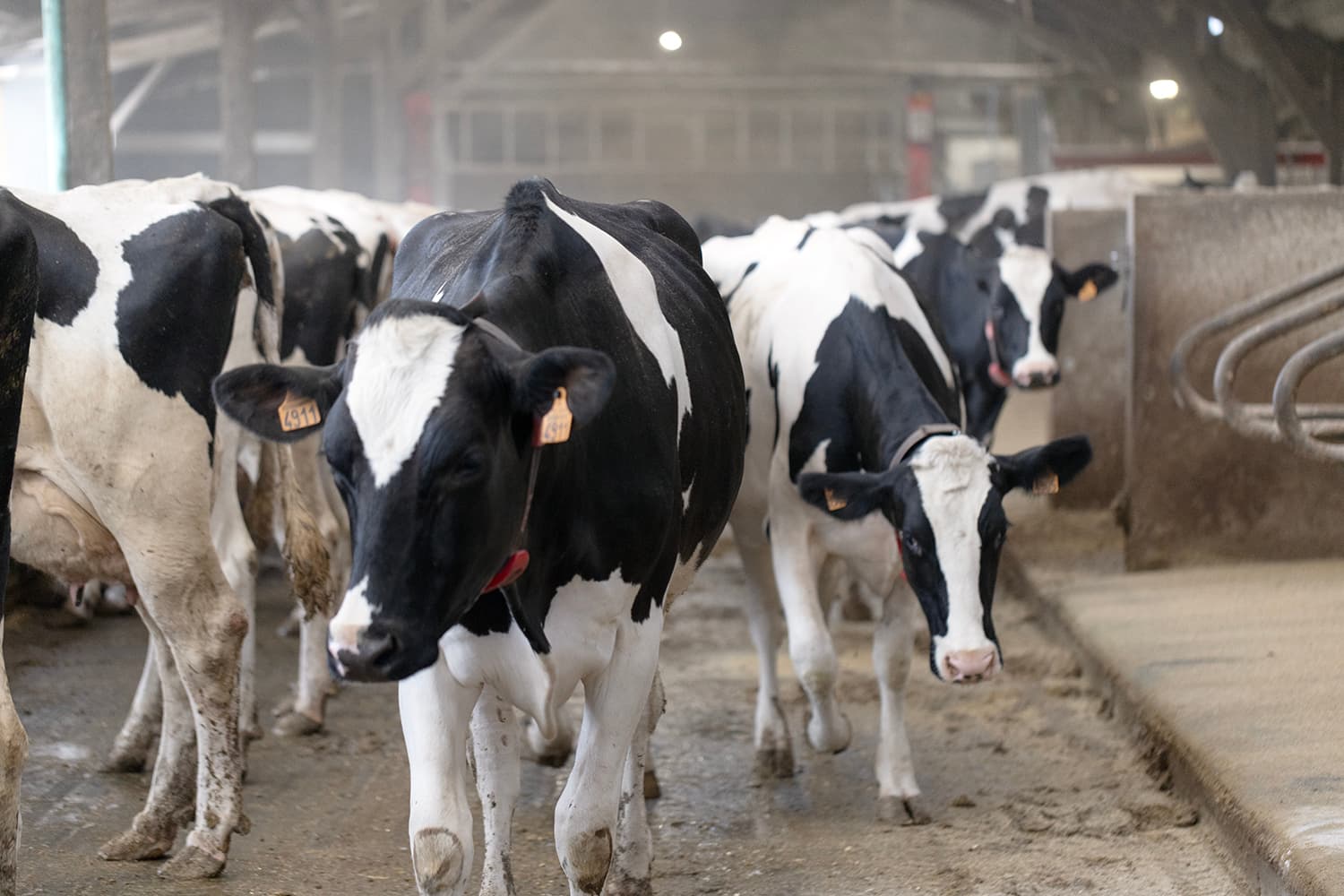
Dairy cows, Fieldwork in France, June 2023. Photograph by Liz Hingley
10.00–12.00 (CET)
Since the 1950s, the industrialisation of dairy farming has sought to regulate cows’ biological processes through scientific techniques, including genetic selection, standardised feeding, and automated milking. These innovations increased productivity while reshaping the temporal and spatial organisation of interactions between farmers and cows. More recently, digital technologies and artificial intelligence have enabled continuous monitoring of cows’ biological rhythms, translating physiological signals into actionable data for farm management.
Existing research on the socio-cultural foundations of industrial farming has often taken an anthropocentric perspective, emphasising industrial regulation and production while overlooking the sensory experiences and lived rhythms of cows and humans in daily practice.
To address this gap, I adopt a multisensory, post-structuralist approach, drawing on 200 hours of ethnographic observation, 60 hours of video recordings, 43 interviews, and archival work on farms in France and the United Kingdom.
The analysis reveals that rhythms of milking and care are neither purely biological nor mechanistic. They emerge through co-constitutions of humans, cows, and technologies, and are perceived and negotiated through sound, movement, touch, smell, and sight. Industrial farm infrastructures, technologies, and materials actively shape these rhythms, coordinating practices and structuring daily management. These rhythms operate as forms of adaptive continuity, through which humans, animals, and technologies continuously adjust while sustaining the regularity required by industrial production. Yet attending to rhythm shows that these adjustments are not smooth or unidirectional; they reveal the granular texture of everyday practices that sometimes align with, and at other times constrain or rework, the industrial system.
For further information, please write to: animalfarm@polito.it